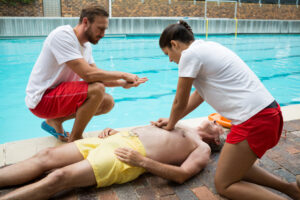
If you work as an NDIS support worker or are considering joining the National Disability Insurance Scheme (NDIS) as a service provider, you’re probably wondering whether a first aid certificate is required. The short answer is yes, most registered NDIS providers require their support workers to hold current first aid qualifications. This guide explains the requirements for NDIS workers, why they matter, and how to get certified quickly.
NDIS Requirements for First Aid and CPR
The National Disability Insurance Scheme does not have a single prescriptive list of mandatory qualifications like some other regulated industries. However, the NDIS Quality and Safeguards Commission publishes the NDIS Practice Standards, which outline expectations for quality and safe service delivery. The Practice Standards include a module on Support Provision, which covers the responsibility of providers to ensure staff are adequately trained to support participants safely.
In practical terms, this means registered NDIS providers have an obligation to ensure their support workers can respond appropriately to health emergencies, including cardiac emergencies and other first aid situations. Most registered NDIS providers translate this into a requirement for support workers to hold current HLTAID009 (CPR) at minimum, and many require HLTAID011 (full First Aid) as well.
The reality on the ground: if you work one-to-one with a person with disability in a home or community setting, you are often the first responder in any emergency. Having current, nationally recognised first aid qualifications means you are trained, confident, and legally protected if an emergency occurs.

Registered NDIS Providers and First Aid Requirements
When you look at job advertisements from registered NDIS providers, you will frequently see “current First Aid certificate (HLTAID009 or HLTAID011)” listed as a requirement or a strong desirable. Some providers are very explicit about this in their Position Descriptions and Induction Checklists. Others may leave it as a more general expectation but enforce it during recruitment.
If you are applying to work for a registered NDIS provider, assume you will need to provide proof of current HLTAID009 or HLTAID011 as part of the hiring process. If you don’t already have a certificate, you should obtain one before applying to most mainstream NDIS providers.
NDIS Participants with High Support Needs

For support workers working with participants who have complex health needs, the importance of first aid certification becomes even more obvious. If you support a participant with a high risk of seizures, dysphagia (swallowing difficulties), severe mobility impairments, or chronic health conditions, your employer may require additional training beyond the standard HLTAID009.
Some participants may have a health management plan that includes specific first aid procedures (for example, the administration of rescue medication in the event of a seizure). In these cases, your HLTAID009 foundation provides the core knowledge, and your employer may provide role-specific training on top of that.
NDIS Workers and Overlap with Aged Care
Many NDIS support workers also provide services to older people or work across both the NDIS and aged care settings. If this applies to you, a single HLTAID009 certificate serves both your NDIS provider and your aged care employer, provided both accept the unit code. This means your annual renewal investment covers both regulatory environments.
The Practical Reality: Annual CPR Renewal
Most registered NDIS providers require annual CPR renewal as a condition of continued employment. This means if your HLTAID009 expires, your employment may be at risk unless you renew promptly. Unlike some industries where in-house training might be accepted, the NDIS sector increasingly values nationally recognised qualifications like HLTAID009 because they demonstrate a portable, auditable standard of competency.
If you work part-time or casual hours across multiple NDIS providers, you know how important flexibility is. FAP First Aid’s express CPR renewal model is designed specifically for people like you. A 30-minute practical session means you can renew your certificate without taking a full day off work.
NDIS Self-Managed Participants and Worker Requirements
If you are a support worker for an NDIS participant who self-manages their funding, the participant and their household may have specific expectations about your qualifications. Even if the registered NDIS provider does not mandate HLTAID009, a self-managed participant may require it as a condition of your engagement. Holding a current certificate makes you a more attractive service provider and can help you secure work.
How to Get Your NDIS-Required First Aid Certificate
If you don’t yet have a first aid certificate, here’s how to get one:
- Decide which qualification suits your role: HLTAID009 (CPR, 30 minutes practical) is suitable if CPR is your primary need. HLTAID011 (full First Aid, 60 minutes practical) is more comprehensive and includes choking, wound management, and other scenarios you may encounter as a support worker.
- Book your session at a time that suits your work schedule. FAP First Aid operates 7 days a week across Australia.
- Complete your online pre-learning before your practical session (this takes about 20-30 minutes and can be done in your own time).
- Attend your face-to-face practical and receive your Statement of Attainment immediately.
Annual Renewal and Compliance
Once you have your first qualification, mark the expiry date on your calendar and plan to renew 4 to 6 weeks before it expires. This ensures you maintain continuous compliance and don’t accidentally fall out of pocket with your NDIS provider.
Many NDIS providers keep records of staff certifications and may send you a reminder when your certificate is approaching expiry. However, it’s your responsibility to ensure you renew on time. Some providers will suspend you from the schedule if your certificate lapses, so staying on top of renewal is essential to your income stability.
Credential | Duration | Practical Time | Cost | Best For |
|---|---|---|---|---|
12 months | 30 minutes | $59 | CPR knowledge and AED use | |
12 months | 60 minutes | $109 | Comprehensive first aid including wounds and choking |
Related reading
- NDIS Quality and Safeguards Commission – Practice Standards
- Australian Government – training.gov.au (HLTAID009 CPR Unit)
Australian Government – training.gov.au (HLTAID011 Provide First Aid Unit)
NDIS Code of Conduct (NDIS Commission)
- Safe Work Australia – First Aid in the Workplace Code of Practice
FAQ
Do NDIS support workers legally need a first aid certificate?
While the NDIS Commission does not prescribe a specific unit code, the NDIS Practice Standards require providers to ensure staff are trained to support participants safely. In practice, most registered NDIS providers require HLTAID009 (CPR) at minimum as a condition of employment.
Is HLTAID009 or HLTAID011 better for NDIS support workers?
HLTAID009 (CPR) is the minimum and is suitable for most support workers. HLTAID011 (full First Aid) is more comprehensive and includes wound management, choking, and other first aid scenarios. Check your NDIS provider’s requirements, as some may specify one or the other.
How often do NDIS workers need to renew CPR?
Most registered NDIS providers require annual CPR renewal as a condition of continued employment. The HLTAID009 certificate is valid for 12 months from the date of completion.
What happens if my NDIS first aid certificate expires?
If your HLTAID009 expires and you have not renewed it, your registered NDIS provider may suspend you from the schedule or terminate your engagement. Some providers allow a short grace period, but it’s best practice to renew before your certificate expires.
Can I renew my NDIS first aid certificate quickly?
Yes. FAP First Aid offers a 30-minute face-to-face CPR practical session, which is perfect for busy NDIS support workers. You complete your online pre-learning at your own pace, then attend the 30-minute practical to renew your certificate.